Building uCrowds - A Journey of innovation and independence
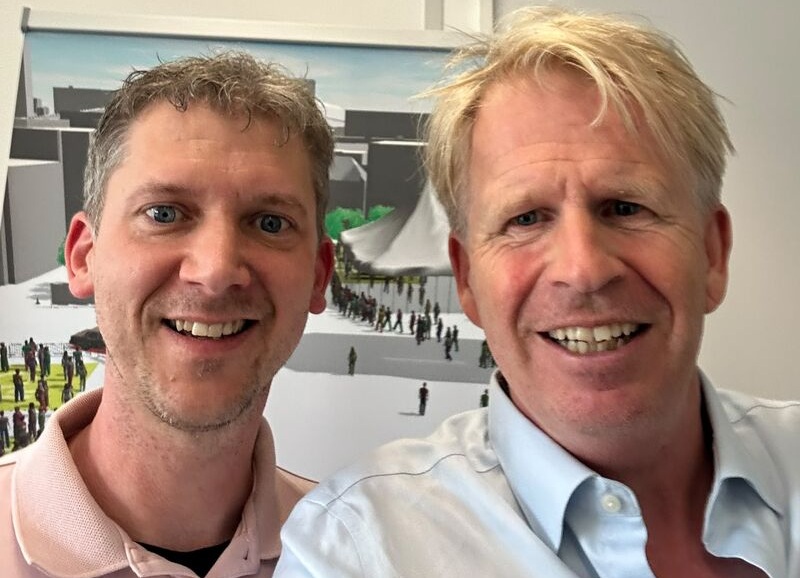
A big thank you to Arjan van den Born (General director at ROM Utrecht Region) for the inspiring conversation and for your kind words. It was a pleasure to reflect on the journey of uCrowds and discuss where we’re heading next.
Looking back, I’m proud of how we’ve built uCrowds. From day one, we deliberately chose an organic growth model. Rather than raising venture capital, we’ve grown primarily through customer-funded innovation projects, supported by an NWO (Dutch Research Council) grant. This allowed us to focus on the long term rather than short-term growth targets, continuously integrating the latest scientific insights from Utrecht University and other research institutes directly into our technology, while retaining our freedom.
Over the years, we’ve had the privilege of working on PoCs with leading international organizations that pushed the limits of what was technically possible. Together with Amazon Web Services (AWS), we demonstrated real-time simulations with more than one million pedestrians. Supported by an Epic Games MegaGrant, we developed technology to visualize and animate these crowds at 4K resolution and 90 FPS. For CAE and BAE Systems, we built country-scale digital simulation tech with massive navigation meshes and ultra-fast path planning.
At the same time, we learned just as much from real-world crowd simulation projects. Working on evacuation studies, ingress and egress analyses, and crowd flow optimization for events such as the Tour de France, La Vuelta, a Holy Mosque in Saudi Arabia, (Fieldlab) SAIL Amsterdam, King’s Day, the Vierdaagsefeesten, and many others has taught us what practitioners truly need. Soon we’ll share more about one of our latest projects: simulating crowd for the F1 at Silverstone, covering a huge environment with 100K-200K visitors.
Reaching this level of performance required more than incremental improvements. We fundamentally rethought how simulation engines should be built: evolving from object-oriented, to data-oriented, and ultimately to memory-oriented computing. Along the way, we completely rebuilt our engine twice, eventually moving the entire core to Rust. They enabled real-time simulations of 200K pedestrians on a modern laptop.
With this foundation in place, we’re entering the next chapter of uCrowds: international scaling through strong distribution partners and strategic collaborations. If you see opportunities to work together, I’d love to connect.
Finally, none of this would have been possible without our incredible team. I’m incredibly proud of what we’ve achieved together. Their expertise, creativity, and perseverance are the real foundation of uCrowds. We’re also fortunate to be part of the outstanding Utrecht startup ecosystem. Organizations such as ROM Utrecht Region, UtrechtInc, Utrecht University, Utrecht Holdings, and many other partners have created an environment in which deep-tech companies can truly grow from academic research into internationally relevant technology.
The next chapter starts now.
#DeepTech #CrowdSimulation #DigitalTwins #SpatialComputing #HighPerformanceComputing #GIS #ArtificialIntelligence #PublicSafety #AcademicEntrepreneurship #ResearchToImpact #Innovation #uCrowds
Read, like and share this post on our LinkedIn!